There was a time when a tiny popup saying Someone from Austin just signed up felt magical.
Now it mostly feels like wallpaper.
That is the real problem with old school social proof tools. They still do the same trick, on loop, for every visitor, no matter what that visitor actually needs. And modern shoppers are not dumb. They scroll fast, ignore faster, and can smell recycled trust signals from a mile away.
So if you are comparing TrustPulse, Proof, Fomo, and CACOptimizer, here is the simple take.
TrustPulse, Proof, and Fomo helped popularize social proof.
CACOptimizer is built for what comes after social proof stops being enough.
The shift nobody wants to admit
Static social proof is fading because static anything struggles in a noisy funnel.
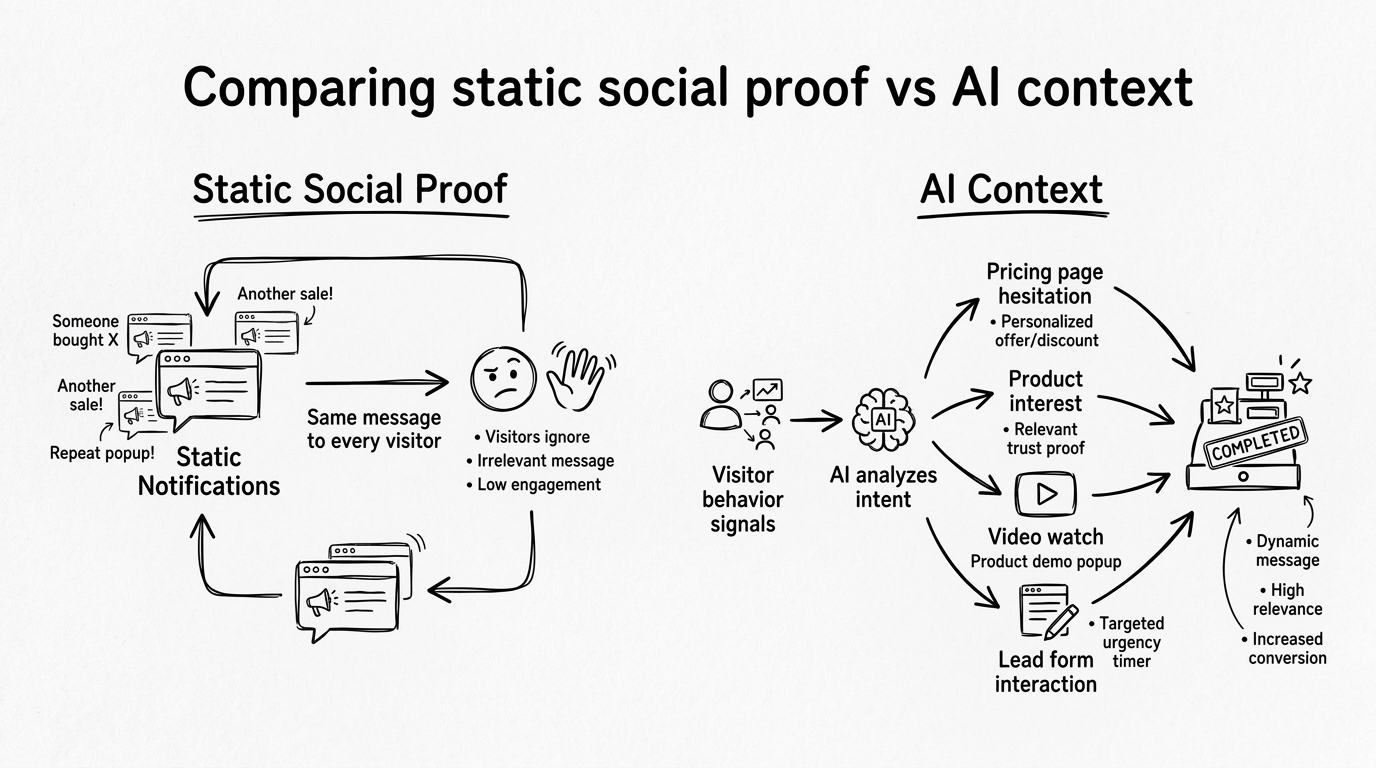
A visitor lands on your site with a question in their head. Maybe they want pricing clarity. Maybe they need reassurance. Maybe they are interested but not ready. A basic popup tool does not really care. It shows the same style of notification to everyone and hopes repetition wins.
That used to be fine when competition was lighter and attention was cheaper.
It is not fine now.
Today, conversion lift comes from relevance. Not just visibility.
That is why more stores are moving from static notifications to dynamic AI context. Instead of showing one generic proof message, the system looks at visitor behavior and responds with the right trust element, video, lead capture, urgency cue, or offer based on what that person is actually doing.
That is a very different game.
What static tools do well
Let us be fair. Tools like TrustPulse, Proof, and Fomo are not useless.
They solve a real issue. If your page feels empty, adding recent activity notifications can help reduce hesitation. A little momentum on the page can make a store feel alive. That matters.
For a small store with low complexity, these tools can be a decent starting point.
But the ceiling shows up fast.
You add one notification stream. Then maybe another. Then maybe a countdown tool. Then a form tool. Then a review widget. Then analytics. Suddenly you have stitched together five separate products to solve one conversion problem.
That is where the stack starts getting silly.
Comparing CACOptimizer with TrustPulse Proof and Fomo
Here is the practical comparison founders actually care about.
TrustPulse
TrustPulse is known for event based social proof popups. It is lightweight and focused on showing actions like signups, purchases, or page activity.
Good for
Simple social proof notifications
Quick setup
Sites that just want basic recent activity cues
Not so good for
Deeper personalization
Video content
Lead capture
Urgency campaigns beyond narrow use cases
Unified visitor intelligence
It is a social proof tool. That is also the limitation.
Proof
Proof made its name by helping brands show recent customer activity and other trust elements. Depending on the product tier, it can support personalization features, but the experience still tends to center around specific proof modules rather than a full conversion layer.
Good for
Brand familiarity
Proof style widgets
Testing trust signals on key pages
Not so good for
Replacing multiple conversion apps in one script
Behavior driven content orchestration
Combining proof, video, urgency, forms, and analytics in one place
Proof helped define the category. The category itself is now being outgrown.
Fomo
Fomo is popular because it integrates widely and gives stores a straightforward way to show social activity notifications across many platforms.
Good for
Integrations
Notification variety
Teams that want fast deployment with familiar popup patterns
Not so good for
Adaptive messaging based on funnel behavior
Built in video proof
Smarter lead capture flows
A single dashboard that ties engagement to conversion actions
Fomo is handy when you want more notifications. It is less handy when you want your site to think.
CACOptimizer
CACOptimizer is not just another social proof popup.
It is a lightweight AI powered conversion layer that combines trust building, engagement, urgency, lead capture, and analytics in one script. Instead of asking whether you want reviews or a countdown or a form or a video, it lets the site deploy the right element at the right moment.
Good for
Social proof plus video plus smart forms plus urgency plus analytics
Behavior based targeting
One line install on Shopify, WordPress, Webflow, Wix, Squarespace, and Next.js
Real time visitor intelligence
Teams trying to reduce tool sprawl and improve conversion rate without a dev project
This is the key distinction.
TrustPulse, Proof, and Fomo mostly help you show activity.
CACOptimizer helps you respond to intent.
Feature overlap in plain English
If you strip the marketing pages down to what these tools actually help you do, the overlap gets pretty obvious.
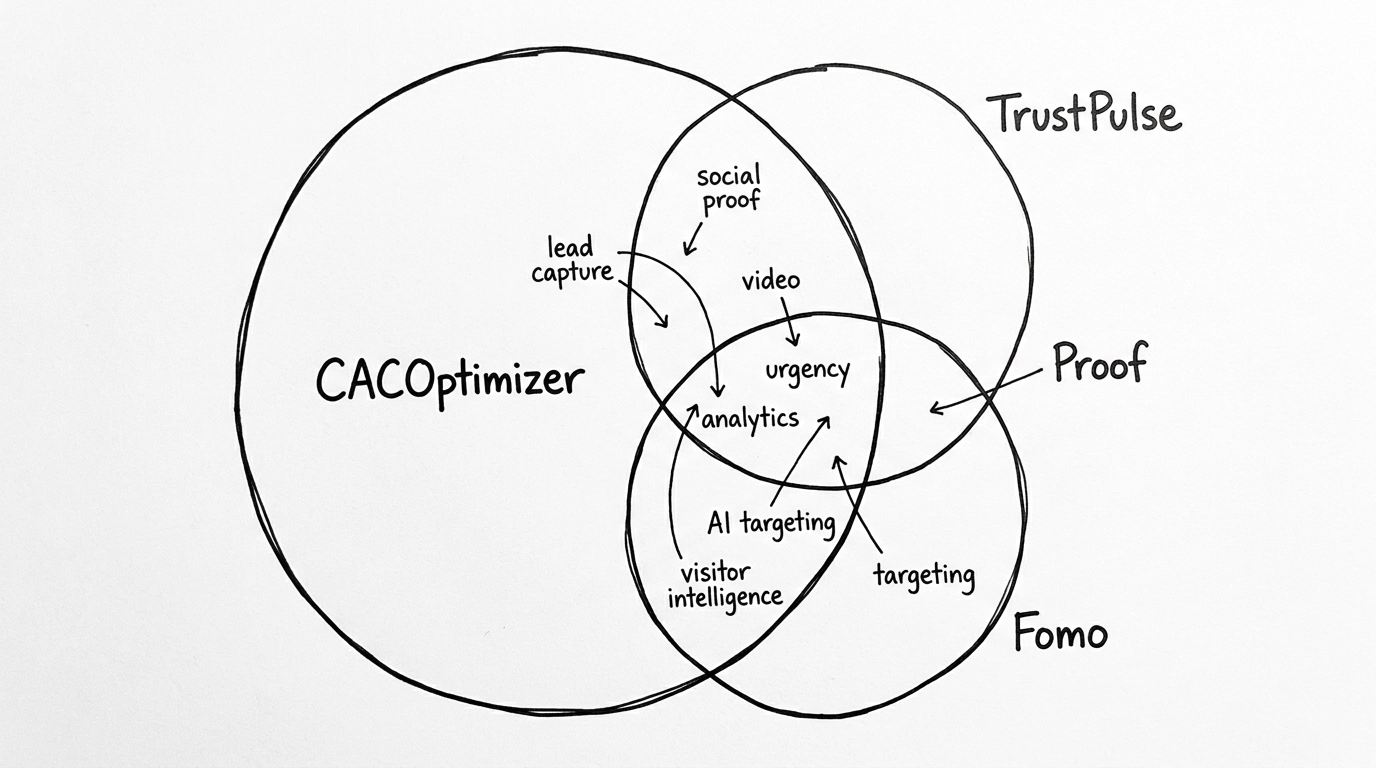
The old tools cluster around one function
Show notifications that create trust through visible activity
CACOptimizer covers that too, but stretches further into the rest of the funnel
Trust through reviews, ratings, logos, and testimonials
Engagement through video content and product walkthroughs
Lead capture through smart forms
Urgency through countdowns and offers
Optimization through real time analytics and visitor tracking
That matters because conversion problems are rarely caused by one missing popup.
Usually the issue is that the page is not answering the right concern at the right moment.
Why dynamic AI context beats static popups
Static social proof says
Here is a thing that happened
Dynamic AI context says
Here is the thing this visitor probably needs next
That difference sounds small until you see it on a pricing page.
Imagine a visitor toggling between monthly and annual pricing.
A basic social proof tool might still show
Someone purchased 2 hours ago
Nice. Fine. Maybe helpful. Maybe ignored.
A dynamic system can treat that toggle behavior as intent.
If the visitor leans toward annual pricing but hesitates, you can surface an annual savings callout, a short demo video, a testimonial from a similar customer, or a lead form offering help choosing the right plan.
That is not decoration.
That is conversion logic.
The monthly annual pricing toggle logic matters more than most brands think
This one gets overlooked all the time.
When someone touches the monthly annual pricing toggle, they are telling you something important. They are not casually browsing. They are evaluating commitment, budget, and risk.
That moment deserves context.
A static tool cannot really react with nuance. It can only keep running its notification feed.
CACOptimizer can use this type of behavior as a trigger. For example
If a visitor checks annual pricing twice, show how much they save over twelve months
If they hover on pricing but do not click, show a customer proof element tied to ROI
If they spend time on a higher tier, show a quick feature explainer video
If they stall, show a smart lead form offering help from sales or support
This is why static social proof is losing steam. It treats all hesitation the same. AI context treats hesitation as signal.
So which one should you choose
If you want a basic recent activity popup, TrustPulse, Proof, or Fomo can still do the job.
If your funnel is simple, your traffic is warm, and you just need a little trust layer, those tools may be enough for now.
But if you are paying for traffic and watching too many visitors bounce, you probably do not need more popups.
You need a system that adapts.
That is the case for CACOptimizer.
It replaces a messy stack of separate tools with one script that can go live in under five minutes, works across major site platforms, and helps you show the right content when the visitor is most likely to care.
And honestly, that is where the market is going.
Not louder notifications.
Smarter timing.
Final thought for the founder refreshing Stripe a little too often
If conversion rates are soft and customer acquisition costs feel rude lately, do not assume you need a total rebuild.
Sometimes your site does not need more traffic.
It needs better instincts.
Basic social proof had a great run. But modern stores need more than a looping stream of generic notifications. They need context. They need timing. They need a site that reacts more like a good salesperson and less like a billboard.
That is the difference between old proof and modern conversion optimization.
And yes, visitors can feel it.
Want to see how dynamic AI context works on a real site? Try CACOptimizer and get live in under 5 minutes.


